














Last December, a Qassam rocket tore through Pinhas and Aliza Amar’s kitchen. Pinhas and Aliza were home with two of their daughters. Aliza was injured, the rest unharmed. The Israeli family is rebuilding its home and renting two houses away.
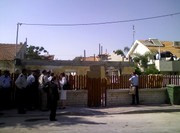 In the southern Israeli city of Sderot, this isn’t big news. But it swept the Amar family into the American presidential campaign. Sen. John McCain met with the family and inspected the damaged house when he visited Israel in March. This week, Sen. Barack Obama dropped by.
The Democratic candidate’s visit was brief. For the Amars, it took up the entire day.
The Amars’ door is always open. On principle. It is the family’s way of life, inherited from Aliza’s parents along with the house where she was born, which now has no roof. First one up opens the door, last one to bed shuts it. In between, everyone and anyone are welcome.
Reporters spotted the family on Obama’s itinerary, and the phones hadn’t stopped ringing. Aliza is having to juggle interview requests while preparing gifts and contemplating food for the distinguished guest. I figure the best way to cover Obama’s visit is to hang out with the family for the day, observing and trying to blend in.
I arrive as Aliza holds court at a dining table that takes up the living room. Over coffee, cigarettes and two cellular phones, the woman who describes herself as “simple” puts army generals to shame. Ordering flowers, outsourcing shopping, giving interviews and commissioning special pastries, the matron shows grace under fire. Some days, it’s Qassam fire. Today, it’s media fire.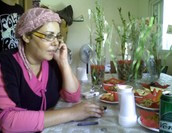
Come in, she signals. I’ll be right with you. Right after Channel 10.
It’s hot. There are fans everywhere. Pinhas steers me out of the sun and into the house. The last of the reporters had left at 11 the previous night, and the first had called before 7 a.m. Wednesday. A bit of chutzpah, no? remarks Aliza, who had spoken to them and countless others anyway.
Someone is sent to make me coffee. So what should I prepare, she frets. The secret service doesn’t allow for the spontaneous mass-scale cooking to which Aliza is accustomed, but she isn’t one to greet Obama empty-handed. Meanwhile, cookies are piled onto plates, along with raisins, nuts and drinks. A long table for a long day.
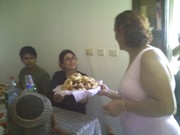
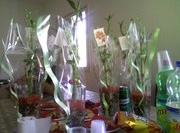 Aliza talks to the florist. The gift she chose for Obama (and his entourage of Israeli ministers) is a “lucky bamboo” plant, promising its owner good fortune and prosperity. Soon these are delivered, joining cellphones, chargers, food and drinks on the table. Still, what to prepare? She decides to keep it traditional but meaningful. Like the bamboo. “We’re Moroccan, we’ll make sfinj,” a doughnut-like puff. The phone is reached for again. Shula? Sfinj? Thank you!
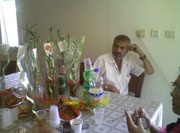
Everyone participates. Pinhas, of sharp thought and gentle speech, directs traffic at the door, nodding reporters in his wife’s direction. He wears a Bluetooth earpiece. Daughter Shavit, 14, is dispatched to the grocery store for more milk.
Cards. Cards. We need cards for the plants. Moshe?! The 20-year-old son is in mandatory service. He’s a wonderful singer. Later he will sing some Bryan Adams for us. But first he must go buy those greeting cards.
I am part of the family by now; the next errand would be mine. The text explaining the lucky bamboo’s virtues is in Hebrew. Sure, I’ll translate it. Printer’s busted? OK, be creative. Shavit volunteers a friend, and off we go. We pass the Amars’ damaged house on the way. She doesn’t give it a second look, having difficulty relating to it like this. What does she miss the most? Having her own room. Now she shares with her sister a hot, stuffy room that is really the reinforced concrete room serving as a bomb shelter. Does she know that today concrete is being poured, two houses down, for the family’s new bomb shelter?
Another phone call aborts our mission. A different solution is found. We will use the computers at the Sderot Media Center, a citizens news agency that brings news from Sderot and is involved with the community.
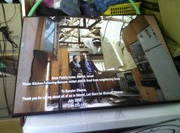 Meanwhile, Ruth from the Israel Project, a journalist resource organization, waltzes into the house. Ta-da! She unveils another gift for Obama: a framed, blown-up photograph of the couple standing in their destroyed kitchen, with a dedication. The impressive memento is propped up on a stack on cardboard boxes containing the family’s life, and a new sink to be installed in the finished house.
She drives me to the small commercial center. OK, let’s get those lucky bamboo blessings into English. The main stalk will grow others. Two stalks promise couples good partnership and love. Three, happiness, joy and longevity. Five, wealth and prosperity and so on. Wait a minute–where’s four?? It’s missing from the Hebrew text. Great. Do I make something up or leave it out? Man, I don’t want to jinx Obama’s lucky bamboo with a bogus blessing. What have I gotten myself into? And what if his sprouts four?
He’s a bright guy, he’ll figure it out. No four.
Meital from the media center prints it out. Glue! We need glue to paste the text to the card. Mission accomplished, we dash back to the house before the Israeli and American security details “secure the perimeter,” secret-service talk for arguing with the media. Shula, the neighbor, walks in with two trays of her fragrant sfinj. Shavit is napping, a pillow over her head. A cheerful Foreign Ministry official is talking protocol with the family, who’s briefed on who stands where and what may be presented. Gifts are in, sfinj is out. Obama doesn’t know what he’s missing.
Last touches on the bamboo. You. You write English. I am entrusted with the card. “Senator Obama,” I write as I’m told, “it was a privilege to host you in our house. We hope you remember Sderot and the Amar family.” Help. Where’s my guardian red squiggle to protect me from misspelling “privilege” and eternal shame? No spell-check here. I double-check with another English speaker. Aliza adds all six of their names in Hebrew, address and phone number too. I frown at my awkward scrawl and an ink smudge. 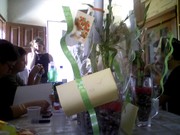
Dogs sniff the plants, photographers look for positions. Shula to the rescue, again. Her balcony has the best view.

The quiet street named for Israel’s 1956 Sinai campaign is taken over by another campaign as neighbors observe the commotion. Strangers draw attention on a street where residents know one another, and this is no ordinary stranger. Alice Cohen has lived in the house across the street since emigrating from Morocco in 1956. Her house has been damaged by rockets too, but she doesn’t want a visit. “When the Messiah comes, I’ll welcome him. This, I don’t need.”
Pleasantries inside, jokes and clicking cameras outside, the visit is over. Obama, fresh and crisp in a white shirt, crosses the street to the neighbors and media pressed against the barricades. 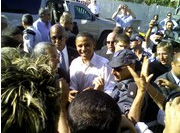 Grinning, shaking hands, he quickly surveys the lot of us standing on the neighbors’ stone wall. Noting the palm trees and the weather, he says, “This is great, it’s like Miami.” You can tell he’s been air-conditioned between engagements.
 Miami it ain’t. “It is GOOD to see you, sir!” he emphatically greets an elderly resident, shaking his hand as vigorously as the spectator could take. A new fan club is born.
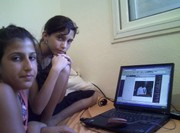
 Back at the house, Pinhas rushes to interview for Channel 10, Tamar is assigned to Channel 2. Shavit and her friend Yamit, who had been in the house too when the Qassam struck, sit on a bed, watching Obama’s news conference live on a laptop. Pinhas is back, sitting on his bed with his wife and youngest daughter Eliya to watch Tamar on TV. Shula is there too and, of course, me.
It’s evening. After one last cup of coffee and another sfinj, I said
 goodbye to the Amars, who just this morning didn’t know me from Adam (or from the dozens of other reporters) but felt like family by the end of the day.
They felt privileged to host Obama. But really, the privilege is his.
— Batsheva Sobelman in Sderot.
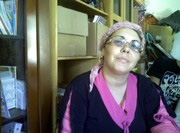
From top to bottom: the house, Aliza Amar, lucky bamboo, Pinhas, picture waiting for Obama, Shula and her sfinj, “The Card,” Rick the photographer on Shula’s balcony, Obama with the neighbors, Aliza, Shavit (right) and Yamit watching Obama on the laptop. Credit: Batsheva Sobelman/Los Angeles Times